
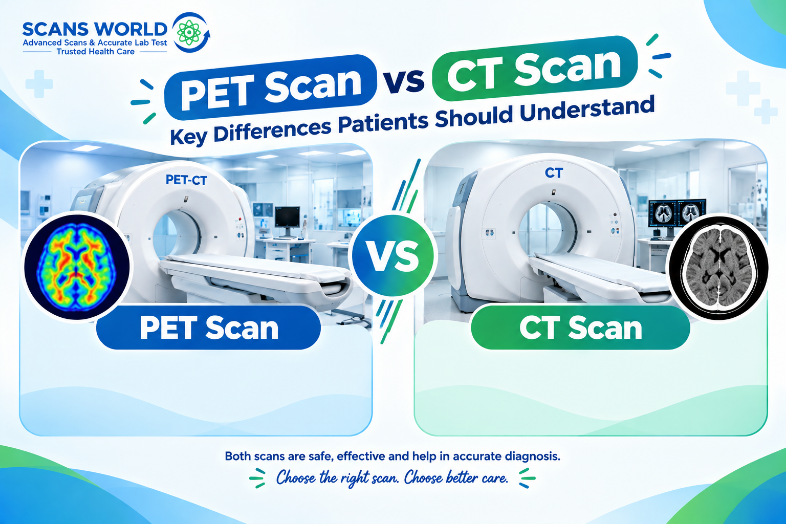
PET Scan vs CT Scan: Key Differences Patients Should Understand
When a doctor asks for a scan, the name of the test can feel like one more thing to worry about. Many patients and family members ask the same thing: “Why a PET scan and not a CT scan?” Or the other way round.
Doctors choose an imaging test based on what they need to find out, your symptoms, your medical history and the results of earlier tests. PET and CT scans both create images of the inside of the body, but they show very different kinds of information.
If your doctor has mentioned PET imaging and you are looking for a pet scan centre in Chennai, it helps to understand what each scan does first. This guide explains the difference between a PET scan and a CT scan in simple terms. It also covers how to prepare and what to look for in a diagnostic centre.
What Is a PET Scan?
PET stands for positron emission tomography. Before the scan a small amount of a radioactive substance, called a tracer, is injected, usually into a vein.The tracer travels through the body and collects in tissues according to how active they are.The scanner picks up signals from the tracer and turns them into images.
The most widely used tracer is a form of glucose (sugar). Cells that use more glucose, including some cancer cells can show up more brightly on the scan. Other tracers are used for specific conditions.
How it works The scanner detects where the tracer collects in the body
- What it shows: A Depending on the tracer, metabolic activity (energy utilization by the cells) or other biological processes
- When a doctor would recommend it: To look at or treat some cancers To see how well treatment is working To assess some brain and heart conditions
- Why context counts: Areas can light up for reasons other than cancer such as inflammation or infection so results are always read alongside your symptom examination and other tests
- Not every patient needs a PET scan. Doctors recommend it only when functional information will genuinely help with diagnosis or treatment planning.
What Is a CT Scan?
CT stands for computed tomography. It uses X-rays taken from many angles and a computer combines them into detailed cross-sectional images like slices of the body.
- How it works: X-ray beams rotate around the body while a computer reconstructs the images
- What it shows: Bones, organs, blood vessels, the lungs and other soft tissues
- When doctors may recommend it: Injuries, suspected internal bleeding, lung conditions, tumours, infections and many other concerns
- What it helps assess: The size, location and structure of an abnormality
CT is fast and very widely used, but it is not the right test for every condition. In some situations, an MRI, an ultrasound or another test may give better information.
PET Scan vs CT Scan: Key Differences
The simplest way to remember it: CT shows what your organs look like, while PET shows how certain tissues are behaving. The table below sets out the main differences.
| Comparison factor | PET Scan | CT Scan |
| Main purpose | Evaluates metabolic activity or selected biological processes | Shows detailed internal anatomy and structures |
| Technology | Uses a radioactive tracer and detects its distribution | Uses X-rays and computer reconstruction |
| Information provided | Functional or molecular information | Structural and anatomical information |
| Common applications | Selected cancer assessments and certain neurological or cardiac evaluations | Injuries, lung conditions, internal abnormalities and many other clinical indications |
| Radiation | Involves radiation from the tracer; additional radiation depends on the imaging protocol | Uses ionising radiation from X-rays |
| Preparation | Depends on the tracer, examination and clinical indication | Depends on the body area, contrast use and examination |
| Examination time | Varies by tracer uptake time and scanning protocol | Varies by body area and scanning protocol |
| Clinical decision | Selected when functional information is needed | Selected when detailed anatomical information is needed |
Neither scan is better than the other overall. A CT scan can show a lump clearly but may not show how active it is. A PET scan can highlight unusual activity but gives less anatomical detail on its own. Each answers a different question, so the right choice depends entirely on what your doctor needs to investigate.
PET Scan vs CT Scan: Which One Do Doctors Recommend?
The choice depends on the medical question. For example:
- A CT scan may be recommended to check for internal injuries after an accident or to look into a structural abnormality.
- A PET scan may be recommended when your doctor needs information about metabolic activity, for instance to see how active a known tumour is.
- A PET/CT scan may be recommended in selected cases. It brings together functional and anatomical information in a single session.
A PET/CT scan is one combined examination done on a single machine. The two sets of images are aligned so that any area of activity can be matched to an exact location. It is not simply a PET scan and a separate CT scan done one after the other. Today, most Pet scan centre in Chennai imaging is carried out as PET/CT.
Your treating doctor will decide which examination suits your situation. If you are unsure why a particular scan has been advised, ask your doctor.
How Should Patients Prepare for a PET Scan or CT Scan?

Preparation depends on the type of scan and your health. General points:
- Follow Centre Instructions:Follow the instructions the diagnostic centre gives you
- Check Fasting Requirements:Check whether you need to fast, and for how long.
- Share Your Health Conditions:Tell the staff if you have diabetes, are pregnant or might be pregnant, are breastfeeding, or have any allergies or other relevant medical conditions.
- Bring Medicines List & Reports:Share your current medicines Carry previous scan reports and images
- Ask About Contrast Dye:Ask whether contrast (a dye that makes some structures easier to see) will be used.
- Follow Fluid & Medicine Advice:Follow your health care teams instructions about drinking fluids or taking medications.
- PET Scan Preparation:You may be told what to eat or refrain from strenuous physical activity before the scan. Because blood sugar levels can affect the way the tracer is taken up, special instructions are often given to patients with diabetes.
- CT Scan Preparation:Many CT scans need no special preparation. When contrast is planned, you may be asked to fast briefly, and your kidney function may be checked first.
- Do not Stop Prescribed Medicines:Do not stop any prescribed medicine unless your doctor or the imaging team specifically tells you to.
For CT scans: Many CT scans need no special preparation. When contrast is planned, you may be asked to fast briefly, and your kidney function may be checked first.
Do not stop any prescribed medicine unless your doctor or the imaging team specifically tells you to.
Understanding Radiation and Patient Safety
PET and CT scans both involve ionising radiation, but from different sources: the tracer in PET and X-rays in CT. The amount varies depending on the examination. Imaging is recommended by doctors when the possible benefit to your diagnosis or treatment outweighs the risk and alternatives are considered where appropriate.
To ensure your safety:
If you are pregnant or think you might be let your team know.
Discuss your medical history and previous scans.
- Ask questions if you are unsure why the scan is needed.
- Follow all instructions from the imaging staff, including any given after the scan.
Choosing a Reliable PET Scan Centre in Chennai
A good pet scan centre in Chennai should make the process clear and comfortable for you not just complete the scan. When comparing option check:
- Whether the centre offers the exact examination your doctor has prescribed
- Qualified radiology and nuclear medicine professionals as appropriate
- Proper radiation safety and quality-control practices
- Clear pre-scan instructions given well in advance
- Transparent information about preparation and charges
- Careful handling of your reports and personal medical information
- Convenient appointment arrangements
- Clear communication about when and how you will receive your report
Before you book with any pet scan centre in Chennai, call ahead to confirm that it offers the specific scan you need and to ask about preparation.
Scans World is a diagnostic centre in Chennai that offers a range of medical imaging services. Patients can contact the team to check which examinations are available at each branch.
A PET scan helps assess metabolic or other biological activity in the body while a CT scan provides detailed images of internal structures. Both play an important role in diagnosis, and in selected cases they are combined as a PET/CT examination to give a fuller picture.
The right scan is the one your doctor recommends for your situation. Talk through your imaging needs with your healthcare professional, and choose a centre that explains each step clearly. If you are comparing options for a pet scan centre in Chenni, Scans World can help you understand the available diagnostic imaginga services.
If you need guidance on diagnostic imaging services, contact Scans World to learn more about the available services. Make an appointment at a branch convenient for you.

 Call Now